
Tucson Commercial Roof Repair Questions
Commercial roof repair questions from Tucson owners and facility managers, answered plainly: leaks, monsoon drainage, metal and industrial roofs, permits, and cost.
Roof Repair Across Tucson And Pima County
Tucson Commercial Roof Repair fixes leaking flat, metal, and industrial roofs on commercial buildings in Tucson, Marana, Oro Valley, Sahuarita, Green Valley, and the nearby communities of Pima County.
Leaks And Roof Condition
Where do flat commercial roofs in Tucson usually leak?
Most flat roof leaks start at edges and openings, where the membrane meets another material. Check these spots on Tucson buildings first.
- Seams dried open by years of summer sun
- Drains and scuppers where debris holds water against the membrane
- Curbs under rooftop HVAC units and exhaust fans
- Parapet walls with cracked stucco or loose coping
- Flashings at pipes, vents, and wall transitions
Flat roof repair targets these details before the open field.
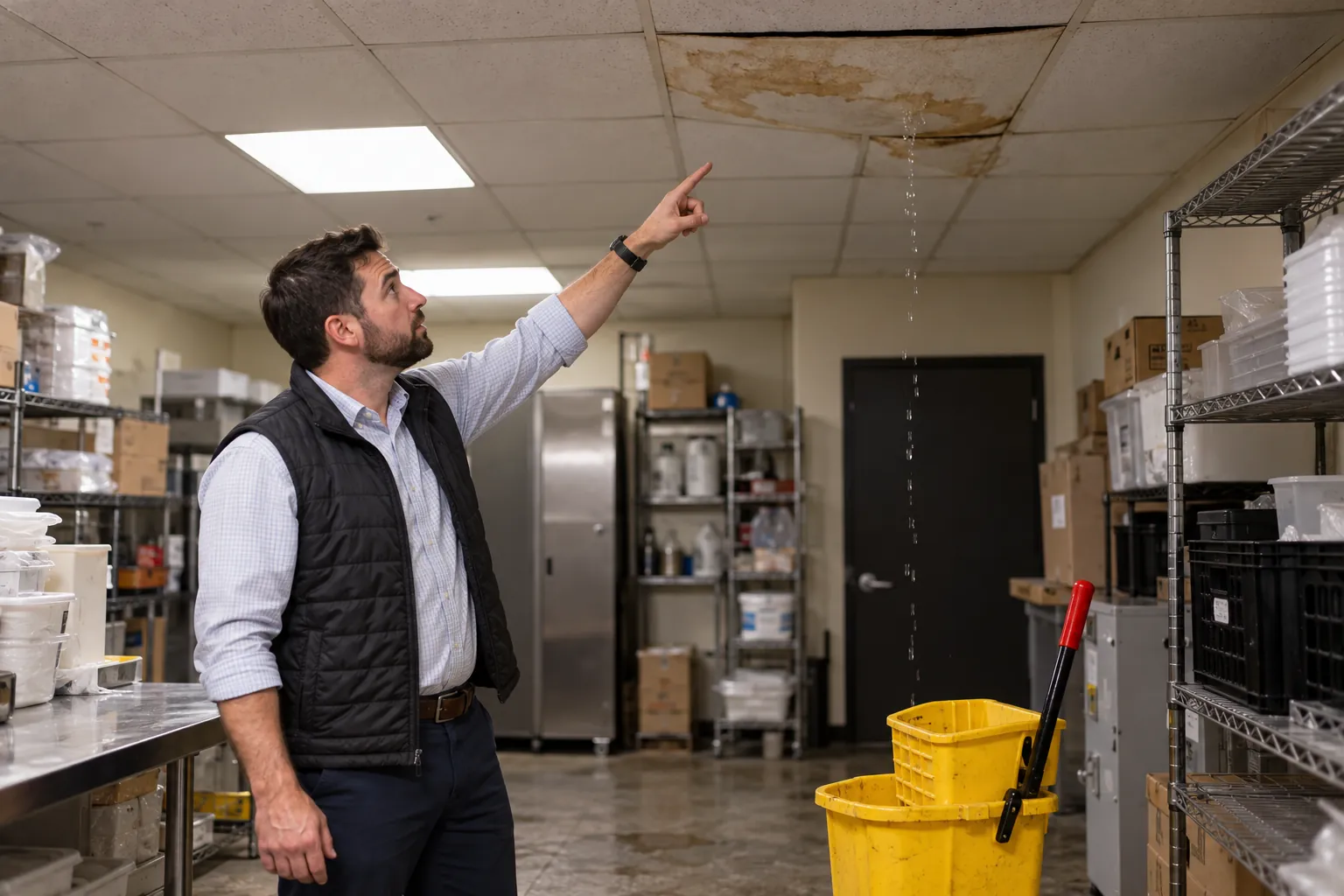
Why is the ceiling stain far from where my roof is leaking?
Water travels before it drips. It enters at a seam, flashing, or fastener, then runs along deck flutes, insulation boards, or a joist until it finds a low point or a gap in the ceiling grid.
Commercial roof leak repair in Tucson starts on the roof above the stain and works upslope, checking every curb, drain, and penetration along the path. A moisture meter or infrared scan helps confirm where insulation is wet.
Can a roof leak be stopped temporarily before the permanent repair?
Yes, temporary leak control is often possible once the roof is dry enough to work on safely. Common stopgaps include taping a split seam with a compatible product, sealing an open flashing, clearing a clogged drain, or covering a punctured area.
These measures limit interior damage while the full repair is planned. A temporary patch is a short-term fix, and the permanent repair should follow once the cause is confirmed.
Should I repair or replace my commercial roof?
Repair makes sense while most of the roof stays dry and the deck is solid. Replacement moves ahead when one of these shows up.
- Wet insulation across large areas, confirmed by core cuts
- Rusted or sagging deck under the membrane
- Repeat leaks at new spots after each repair
- Membrane that is brittle, shrinking, or pulling at the perimeter
Age matters too. A roof near the end of its service life rarely justifies big repair spending.
How long does a commercial roof repair last?
A good repair lasts about as long as the roof around it holds up. New flashing on a membrane with years of life left can perform for a long time, while a patch on a brittle, sun-baked membrane can fail at the next edge.
Drainage, foot traffic around rooftop units, and how quickly new damage is found after monsoon season all affect how long the fix holds.
Metal And Industrial Roofs
What causes leaks on a commercial metal roof in Tucson?
Movement causes most metal roof leaks. Panels expand in afternoon heat and contract overnight, and over the years that cycle works fasteners loose and opens laps. Commercial metal roof repair here usually addresses these problems.
- Backed-out screws with worn neoprene washers
- Panel laps where sealant has dried and split
- Rust bloom around fasteners, cut edges, and ponding spots
- Skylight panels that have cracked, yellowed, or pulled away from their curbs
How do you repair an industrial roof around equipment and production?
Industrial roof repair is planned around the plant's schedule and safety rules. Crews coordinate with the facility team on hot work, shutdown of rooftop fans, and exhaust stacks that discharge heat or residue onto the membrane.
Damage often clusters around equipment curbs, pipe supports, and walkways where technicians step. Work can be staged by roof section so production lines, loading docks, and shipping keep running underneath.
Monsoon, Sun, And Storms
Why do older Tucson flat roofs overflow during monsoon downpours?
Older flat roofs were often built with too few drains, and a short monsoon cell can drop more water than they can move. Leaves, dust, and gravel collect at drains and canales, and the water backs up behind parapets. Once it rises above a flashing or seam, it gets inside.
The National Weather Service in Tucson treats June 15 through September 30 as monsoon season, so late spring is the time to clear drains and check ponding rings.
How does Tucson's climate wear down a commercial roof?
Sun, heat swings, and short, violent storms do most of the damage. Ultraviolet exposure dries out membranes and sealants until seams crack. Daily temperature swings stretch flashings and back out metal fasteners.
Monsoon storms then bring wind that lifts edge metal, hail that bruises membranes, and heavy rain that tests every drain at once. Blistering and alligatored surfaces on older built-up roofs are common signs of that wear.
What should I do after wind or storm damage to my commercial roof?
Start by documenting the damage once the storm passes and the roof is safe to walk.
- Photograph lifted edge metal, torn membrane, dented panels, and ceiling stains.
- Keep notes on the storm date and when each leak appeared.
- Have the roof inspected so damage is recorded across the full surface.
- Limit interior damage with temporary measures and keep the receipts.
- Report the claim to your insurer promptly, since policies often set reporting deadlines.
What maintenance keeps a Tucson commercial roof from leaking?
Two inspections a year, one before monsoon season and one after, catch most problems early. Between them, keep these tasks on the calendar.
- Clear drains, scuppers, gutters, and canales of debris and dust
- Check sealant at curbs, pitch pans, and panel laps
- Walk the perimeter for loose coping and lifted edge metal
- Mark blisters, ponding rings, and new ceiling stains for repair
- Keep rooftop technicians on walk pads
Historic Buildings And Canales
Can adobe-era parapets and canales be repaired without changing their look?
Yes, in most cases. Canales are the spouts that carry water through a parapet, and on older Tucson buildings the leaks usually come from cracked plaster around the canale, a failed membrane wrap inside the parapet, or a spout pitched back toward the roof.
Repairs reseal and reflash the opening, rebuild cap plaster, and correct the pitch while keeping the original spout and wall profile wherever possible.
Does a historic building in Tucson need design review for roof repairs?
It can, based on where the building sits. The City of Tucson has historic preservation zones, including El Presidio, Armory Park, Barrio Historico, West University, and Fort Lowell, where exterior alterations go through design review, even some work that needs no building permit.
Repairs that change a parapet, canale, roof edge, or visible roofing material are the most likely to be reviewed, so check with the city early.
Permits, Cost, Taxes, And Utilities
Who issues commercial roofing permits in Tucson and nearby towns?
It depends on whether the building sits inside a city or town or in unincorporated Pima County.
| Area | Permit office |
|---|---|
| Tucson | City of Tucson Planning & Development Services |
| South Tucson | City of South Tucson Development Services |
| Marana | Town of Marana |
| Oro Valley | Town of Oro Valley |
| Sahuarita | Town of Sahuarita |
| Catalina Foothills, Casas Adobes, Flowing Wells, Drexel Heights, Valencia West, Vail, Catalina, Green Valley | Pima County Development Services (unincorporated Pima County) |
Permit thresholds for repair work vary by jurisdiction. Confirm with the right office before work on the deck, drains, or rooftop equipment supports begins.
What affects the cost of a commercial roof repair?
Cost depends on the size of the problem and how hard it is to reach. These factors carry the most weight.
- Roof system type, such as TPO, built-up, modified bitumen, or metal panels
- Number of leak points at seams, curbs, drains, and parapets
- Extent of wet insulation or deck damage found once the roof is opened
- Access, including roof height, ladders, lifts, and hatch location
- Scheduling around tenants, production, or equipment shutdowns
Can commercial roof work qualify for Section 179?
Yes, roof improvements on existing nonresidential buildings can qualify for the Section 179 deduction. For 2026 the limit is $2,560,000, per IRS Publication 946. Roofs on residential rental property are excluded.
Smaller repairs, such as resealing a curb or swapping a few metal panels, are often handled differently than a larger roof improvement, so ask a CPA how your roof work should be classified.
Do TEP or Trico offer incentives for commercial roof work?
Programs change, so check with your utility before work starts. Tucson Electric Power serves most of the Tucson area, and Trico Electric Cooperative covers parts of northwest Tucson, Marana, Sahuarita, and Green Valley, according to Pima County.
Cool roof incentives usually call for a product listed in the Cool Roof Rating Council directory, so ask before choosing a reflective membrane or coating for a repaired flat roof section.
Service Area And Getting Started
What areas do you serve?
Tucson Commercial Roof Repair works across Tucson and these nearby communities.
| Area | Roof angle |
|---|---|
| Marana | I-10 distribution and industrial roofs |
| Oro Valley | Medical offices, business-park roofs |
| Catalina Foothills | Hillside access and runoff planning |
| Casas Adobes | Retail centers, crowded rooftop units |
| Flowing Wells | Aging built-up roofs, tired drains |
| South Tucson | Masonry storefronts with parapets |
| Drexel Heights | Metal shops on larger lots |
| Valencia West | Dust-filled scuppers and gutters |
| Vail | I-10 metal and low-slope buildings |
| Catalina | Small Oracle Road commercial buildings |
| Sahuarita | Agricultural and light industrial metal |
| Green Valley | Clubhouses, medical offices, retail |
How do I get started?
Call us or request a free estimate to set up a free roof inspection. The inspection looks at these areas.
- Membrane, seams, and panel laps across the field of the roof
- Drains, scuppers, canales, and signs of ponding
- Flashings and curbs at parapets, skylights, and rooftop equipment
- Interior ceiling stains, matched to entry points above
- Moisture in the insulation wherever readings point to it
You get a plain explanation of what needs repair now and what can wait.
Sources named in these answers:
- City of Tucson Planning & Development Services: Permits
- City of Tucson: Historic Designations and Design Review
- City of South Tucson Development Services: Permits
- Town of Marana: Do I Need a Permit?
- Town of Oro Valley: Apply for a Building Permit
- Town of Sahuarita: Do I Need a Permit?
- Pima County Development Services
- Pima County: Utilities
- IRS Publication 946: How To Depreciate Property
- Cool Roof Rating Council: Rated Roof Products Directory
- National Weather Service, Tucson
More Commercial Roof Repair Questions In Tucson?
Call with the question or request a free estimate, and we will answer it with your roof in front of us.